 SENDO
SENDO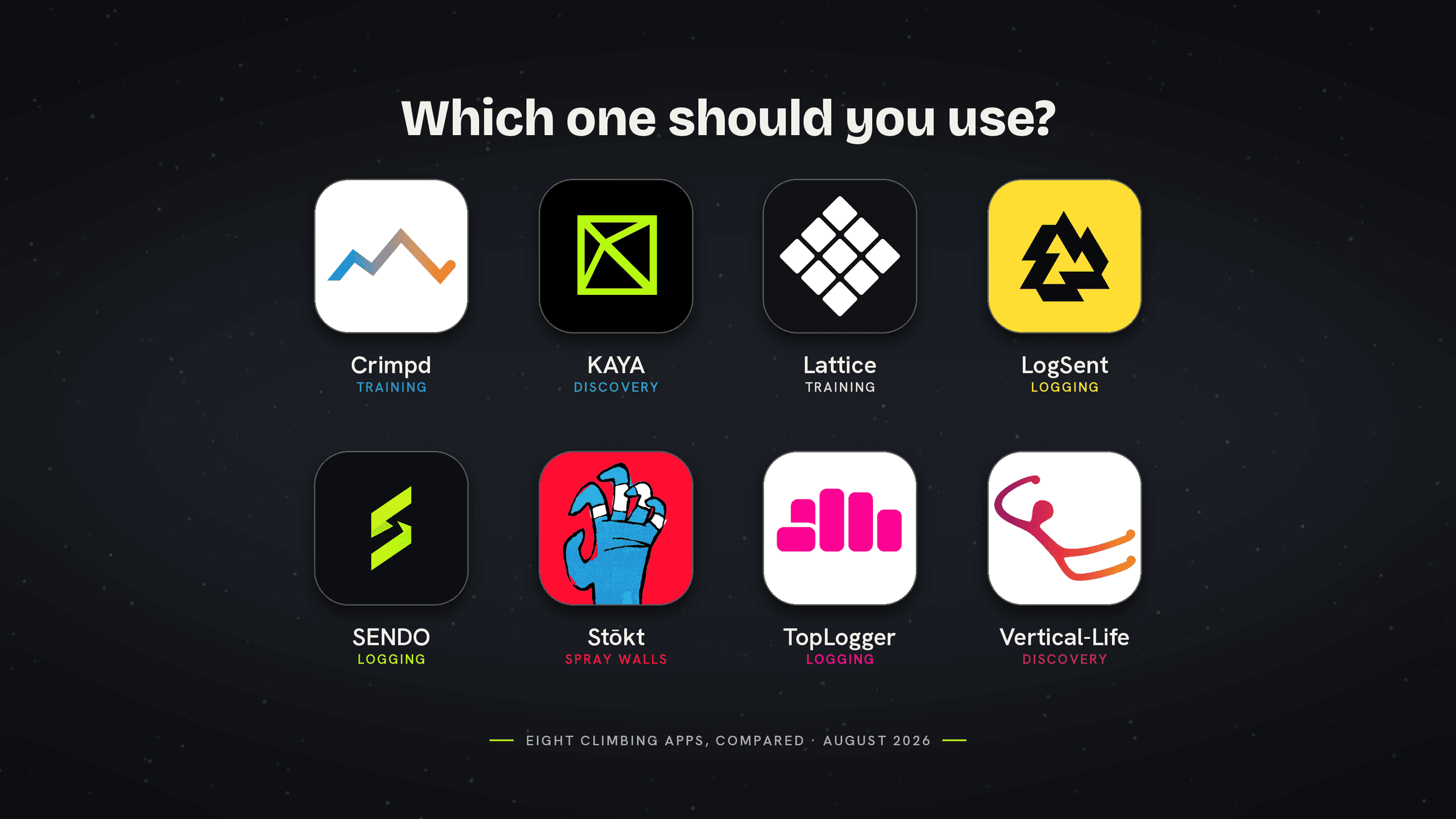
“What’s the best climbing app?” is the wrong question, because the apps that get compared aren’t trying to be the same thing. One is a training coach. One is a social network with a guidebook attached. One lives on your wrist. One is glued to your gym’s wall map. The useful question is which one fits how you climb, so that is how this guide is organized.
Eight of 2026’s main options are below, judged on the same terms and listed alphabetically so none of them gets a home-field advantage. Four short tables, one question each: what the app is for, where it works, what happens when the signal drops, and what it costs.
At a glance
Five questions, eight apps, one dot each. This is the whole comparison compressed; the tables after it are the same information with the reasons attached.
| App | Any gym | Offline | Watch | Android | Free tier |
|---|---|---|---|---|---|
| Crimpd | No | Partly | No | Yes | Yes |
| KAYA | Partly | Partly | No | Yes | Yes |
| Lattice | No | Partly | No | Yes | No |
| LogSent | Yes | Yes | Yes | No | No |
| SENDO | Yes | Yes | Yes | Yes | Yes |
| Stōkt | Partly | Partly | No | Yes | Yes |
| TopLogger | Partly | Partly | No | Yes | Yes |
| Vertical-Life | Partly | Partly | No | Yes | Yes |
One row is complete, which is the case for SENDO in a single line. The gaps in the others are not oversights: a training app has no reason to work at an unknown gym, and a guidebook platform is meant to be tied to the places it has mapped.
What each app is for
| App | Job | Built around |
|---|---|---|
| Crimpd | Training | A large workout library, most of it free |
| KAYA | Discovery + social | Outdoor climbs, beta videos, a friend feed |
| Lattice | Training | A coach-built plan that adapts as you log |
| LogSent | Logging | One-tap logging from an Apple Watch |
| SENDO | Logging | A fast personal log that works at any gym |
| Stōkt | Logging + discovery | Spray walls and home walls |
| TopLogger | Logging | Gym wall maps and live leaderboards |
| Vertical-Life | Discovery + logging | Outdoor topos, plus gyms on its platform |
Where it works
This is the column that decides whether an app survives a change of gym. Some apps log against a grade, so any wall in any city works. Others log against a venue, which is excellent while you are in that venue and useless the moment you leave it.
| App | Any gym? | Runs on |
|---|---|---|
| Crimpd | Not its job | iPhone, Android |
| KAYA | Partner gyms | iPhone, Android |
| Lattice | Not its job | iPhone, Android |
| LogSent | Any gym | iPhone, Apple Watch |
| SENDO | Any gym | iPhone, Android, Apple Watch |
| Stōkt | Walls added to Stōkt | iPhone, Android |
| TopLogger | Partner gyms | iPhone, Android |
| Vertical-Life | Partner gyms | iPhone, Android |
When the signal drops
Climbing gyms are steel-framed boxes, often in basements, and crags are usually out of reception. Look at how often offline access turns out to be a paid feature: for this sport, that is part of the price rather than a footnote to it. The wrist column matters for the same practical reason, which is that a phone in a locker cannot log anything.
| App | Works offline | On your wrist |
|---|---|---|
| Crimpd | Limited | No watch app |
| KAYA | Offline topos need Pro | No watch app |
| Lattice | Limited | No watch app |
| LogSent | Yes, on the watch too | Yes: the watch is the app |
| SENDO | Yes, by default | Yes: log, workout, rest timer |
| Stōkt | Limited | No watch app |
| TopLogger | Limited | No watch app |
| Vertical-Life | Offline topos need Premium | No watch app |
What it costs
Price is where these apps differ most, and not only in amount. A one-time unlock, a monthly subscription and a gym-funded free app are three different relationships with your wallet, and each one shapes the product: free-for-climbers apps answer to the gyms that pay for them, subscriptions have to keep justifying themselves every month, one-time purchases have to be worth buying once.
| App | Free tier | To unlock everything |
|---|---|---|
| Crimpd | Workout library and timers | Crimpd+, $12.99/mo or $59.99/yr |
| KAYA | Feed, ticks, partner-gym sets | KAYA Pro, $9.99/mo or $59.99/yr |
| Lattice | 14-day trial | LatticePlan, £22.99/mo or £124.99/yr |
| LogSent | None, $2.99 up front | Nothing further to buy |
| SENDO | The whole logger, watch included | Pro $19.99 once, or $19.99/yr with cloud backup sync |
| Stōkt | Everything, for climbers | Wall owners pay, from about $40 a wall |
| TopLogger | Everything, for climbers | Gyms pay, not climbers |
| Vertical-Life | Gym following, logging, rankings | Premium, $8.99/mo |
First, what job are you hiring an app for?
These tools split cleanly into three jobs:
- Logging. Recording what you climbed, so progress becomes visible over months instead of vanishing at the end of the session.
- Discovery. Finding new climbs, indoors (fresh sets) or outdoors (crags, topos, beta).
- Training. Programming strength and endurance across a season.
Plenty of climbers end up running two apps for two jobs, usually a logger and a trainer. That is normal, and it is cheaper than chasing one app that claims to do everything.
Crimpd
Crimpd, from the team at Lattice Training, is a training app rather than a send logger, but it comes up in every “best climbing app” conversation so it is worth placing. The free tier is unusually generous: a large library of workouts built on data from tens of thousands of tested climbers, with timers that walk you through each session. Crimpd+ adds structured plans and deeper analysis for $12.99 a month or $59.99 a year.
Best if the goal this season is measurably stronger fingers rather than a nicer logbook. Watch for the mismatch: this is not where you record daily ticks, so it usually gets paired with a logger.
KAYA
KAYA is the scene’s social network and outdoor guidebook rolled together: a large library of outdoor climbs with GPS maps and offline topos, beta videos, gym partnerships with new-set notifications, and a feed of what your friends are climbing. For climbing that spans indoors and outdoors, with the community layer included, few apps match it.
Best if you climb outside a lot and enjoy the social side. Watch for the paywall, since GPS, offline mode and advanced tracking need KAYA Pro at $9.99 a month or $59.99 a year, and for the sheer size of the app if all you wanted was to log a gym session.
Lattice
Lattice’s own app is the coaching end of the same house. LatticePlan generates an adaptive, periodized program from a physical assessment and adjusts it as you log sessions, for £22.99 a month or £124.99 a year after a two-week trial. It is the most expensive thing on this list, and the only one that behaves like a coach rather than a tool.
Best if you are training for a specific goal and want the programming decided for you. Watch for the price, and the same gap as Crimpd: it is not a logbook for your ticks.
LogSent
LogSent is a lean, privacy-minded logger whose signature feature is being an Apple Watch app. Attempts, sends and flashes are one tap from the wrist between goes, it stores data locally, it works offline, it reads heart rate and calories into Apple Health, and it costs a flat $2.99 with no subscription. It supports V-scale and Font, switchable from the watch.
Best if you are all-in on Apple and want the shortest possible path from topping out to logging it. Watch for the platform ceiling, which is iPhone and Apple Watch only with no Android, and a deliberately minimal feature set beyond the tick itself.
SENDO
SENDO is a focused personal logger for indoor bouldering. Logging is a one-tap grade pad, the database is local first so an ascent lands the instant you tap it whether or not the basement has signal, and V-scale, Fontainebleau and Japanese kyu/dan are normalized into one history, so climbing abroad doesn’t fracture your stats. There is a boulder grade converter and a route grade converter on this site if you want to do that conversion by hand. Gyms strip routes every few weeks; the sessions, the calendar and a yearly heatmap of every visit survive the strip.
Since version 2.0 there is an Apple Watch app, and it is a fuller one than the phone-plus- wrist split usually gets: start and end a session from the wrist, tap grades on a watch-sized pad, and the session runs as a real HealthKit workout with live heart rate and calories, plus a rest timer with a haptic finish and a watch-face complication. Those metrics land on the session in your history rather than only in Health, and wrist taps queue up and sync later if the phone is in a locker.
The logger, offline use and the watch app are free on iOS and Android. Pro is a $19.99 one-time purchase for deeper insights and premium sharing; a $1.99 monthly or $19.99 yearly subscription adds cloud sync across devices and includes Pro.
Best if you mostly climb indoors and want a fast, private record that works at any gym. Watch for the flip side of that focus: there is no outdoor guidebook and no social feed, and gyms are added by climbers rather than through partner deals, so a brand-new gym may need naming before it has a name.
Stōkt
Stōkt is the go-to for spray walls and home walls: photograph a wall, tap holds on the photo to create a climb, share it, and log sends against it. For climbers it is free, because the money comes from wall owners and gyms, who pay per wall setup (roughly $40 and up depending on hold count, with a fee again to reset the wall) and can subscribe to Stōkt Pro for benchmarking, competitions and LED integration.
Best if you project on a spray wall or built one in your garage. Watch for the dependency on somebody having uploaded that wall, and the renewal fee if that somebody is you.
TopLogger
TopLogger is built around the gym building. At partner gyms you get an interactive wall map, tap a boulder to tick it as a top or a flash, and land on a live leaderboard, all free for climbers because gyms pay for the platform. The filters are strong (grade, color, wall, circuit, climbed or not) and a feed surfaces friends’ sessions and fresh sets.
Best if your home gym is on TopLogger and leaderboards motivate you. Watch for the dependency: the experience only exists at partner gyms, so a new gym or an outdoor day leaves you without it.
Vertical-Life (8a.nu)
Vertical-Life is two products in one: a mature outdoor guidebook platform, home to the old 8a.nu logbook, and a gym-management system. At gyms on its platform you can follow the gym, see newly set routes with setter notes, join challenges and check rankings for free. Outdoor topos, offline downloads and training plans come with Premium at around $8.99 a month, and some printed partner guidebooks include a code that unlocks Premium content for a while.
Best if you are invested in a crag scene it covers well, or your gym runs on it. Watch for the same partner-gym limit indoors, and that the outdoor value is a subscription.
Also worth knowing
Beyond the eight above, a few apps are built watch-first rather than phone-first: Pinnacle Climb Log ($3.99) and Redpoint both log from the wrist, and Climb Meter uses the watch barometer to measure vertical gain, which works better on routes than on boulders. Both stores also carry a long tail of one-screen logbooks: enter a grade, see a running total, nothing else. They cost a dollar or two, or are free with ads, and they are worth a look only if the barest possible record is genuinely all you want. Several gym chains ship their own app too, worth having for door entry and class booking even when the logging side is thin.
Our top 3
If you want one answer rather than eight, here is the ranking, weighted for the most common way these apps get used: indoor bouldering, a couple of sessions a week, wanting the record to still be there next year. The two training apps are left out of it, since they are not competing for the same slot on your phone.
- 1SENDO, the winner
It wins on reach rather than on feature count. Of the eight compared here it is the only app that logs at a gym it has never heard of, works offline without a paywall, runs on both iPhone and Android, and has an Apple Watch app, with the logger free on every one of them. For someone whose climbing is mostly indoors, nothing else covers all four.
- 2KAYA, runner-up
The best answer if your climbing does not stay indoors. The outdoor library, GPS maps, offline topos, beta videos and the friend feed are a genuine one-app-for-everything proposition, and no logger on this list competes with the discovery side. It is second because that comes as a $9.99 a month subscription and a much bigger app than a gym session needs.
- 3TopLogger, third
The best free experience in the building, if the building is a partner gym: a live map of every current boulder, one tap to tick it, and a leaderboard against everyone else there. Third because you do not get to choose whether your gym signs up, and the whole thing goes quiet the moment you climb somewhere else.
Just outside: LogSent, which does the winner’s job at a lower price and higher speed on the wrist, held back only by being iPhone and Apple Watch alone. Stōkt and Vertical-Life are specialists that win their own categories, spray walls and crag guidebooks, rather than this one.
Match it to how you climb
A ranking is a blunt instrument, though, and habits beat averages:
- Mostly indoors, want a fast personal record → SENDO. Of the eight here it is the only one that logs at any gym, works offline without a paywall, runs on both phone platforms and has an Apple Watch app, and the logger costs nothing. LogSent is the leaner, cheaper version of the same idea if you are iPhone-only.
- Indoors plus plenty of outdoors, want social and discovery → KAYA.
- Driven by your gym’s leaderboard → TopLogger, or Vertical-Life if that is the platform your gym runs.
- Chasing a strength goal this season → Crimpd for workouts you pick yourself, Lattice if you want the plan written for you, paired with a logger either way.
- Projecting on a spray wall → Stōkt.
- Refusing to pay a subscription → TopLogger and Stōkt are free outright, LogSent is $2.99 once, and SENDO is free with an optional one-time unlock.
FAQ
Which climbing app is best for indoor bouldering?
For logging indoor sessions at any gym, SENDO. It works at gyms that have never heard of it, logs offline without a paywall, runs on iPhone, Android and Apple Watch, and the logger itself is free. TopLogger is the better pick if your gym is one of its partners and you want its wall map and leaderboard, and LogSent is the leanest option if you only use Apple devices.
Is there a good free climbing logging app?
Several. TopLogger and Stōkt are free for climbers because gyms and wall owners pay for the platform, so their coverage stops where that funding does. SENDO is free including offline logging and its Apple Watch app, with optional paid extras. KAYA and Vertical-Life both have free tiers but keep offline access behind a subscription.
Which climbing apps work on Apple Watch?
Of the eight compared here, LogSent and SENDO. LogSent is watch-first: the wrist app is essentially the whole product. SENDO added a watch app in 2026 that logs into the phone log and records the session as a HealthKit workout with live heart rate, plus a rest timer and a watch-face complication. Outside this list, Pinnacle Climb Log and Redpoint are also built around the watch.
Do I need a subscription to log my climbs?
No. TopLogger and Stōkt are free outright, LogSent is a single $2.99 purchase, and SENDO is free with an optional one-time Pro unlock. Subscriptions mostly buy things beyond the tick itself: outdoor guidebooks, offline topos, coaching plans or cloud sync across devices.
Are these apps only for bouldering, or do they work for rope climbing?
All eight work for bouldering. Three are bouldering-only: SENDO, LogSent, and Stōkt, whose spray walls are boulder problems by definition. TopLogger logs routes as top-rope or lead at gyms with rope walls, KAYA covers sport and single-pitch trad outdoors as well as boulders, and Vertical-Life goes as far as multi-pitch. Crimpd and Lattice are training apps and are not tied to a discipline at all.
Which climbing app works at any gym?
SENDO and LogSent, because they log against grades rather than against a specific venue, so a gym they have never heard of makes no difference. KAYA, TopLogger and Vertical-Life need your gym to be on their platform, and Stōkt needs somebody to have photographed and uploaded the wall.
Whichever you choose, the app matters less than the habit. The single thing that makes any of them worthwhile is logging often enough that the grade that shut you down in spring is plainly a warm-up by autumn. If a fast, private, any-gym logger is the shape you want, SENDO is free on both stores, and if you are brand new to all of this, start with what to expect at your first session.